
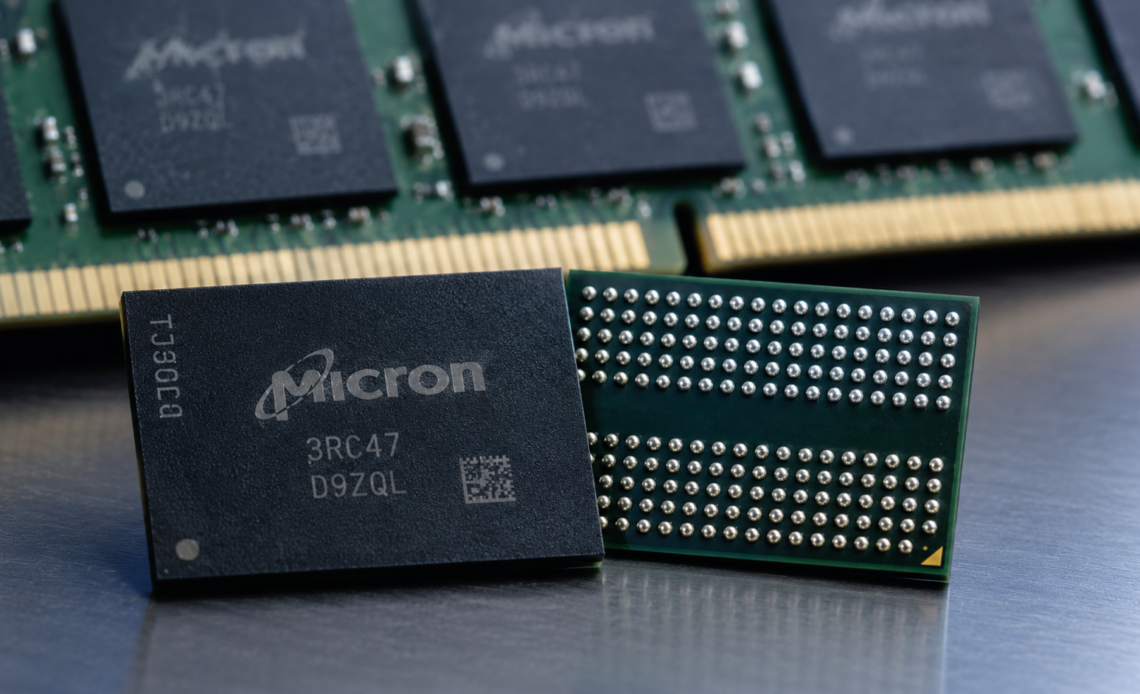
Shares of major memory-chip companies jumped on Thursday as easing oil prices and Treasury yields improved broader sentiment toward technology stocks, helping the sector recover some of the losses suffered earlier in the week.
Micron Technology MU rose about 5.5%, while SK Hynix gained more than 4% and SanDisk climbed roughly 5%.
The gains came after a weak stretch for memory stocks.
The stocks have been jolted into declines on Monday along with the broader category of chip stocks, as investors reacted to concerns that a slowdown in AI development could eventually translate into weaker demand for the chips and memory products powering the industry.
Micron had fallen about 2% over the previous five sessions, while SK Hynix dropped more than 5% and SanDisk declined about 7%.
Additionally, rising oil prices pushed Treasury yields higher even as investors awaited the Federal Reserve’s interest-rate decision, keeping pressure on the stocks.
The Fed’s rate hike on Wednesday, its first since July 2023, also helped reassure markets about its focus on containing inflation.
Oil and bond yields provide relief
Higher energy prices and bond yields can put pressure on growth-oriented technology stocks by raising concerns over inflation, interest rates and borrowing costs.
On Thursday, however, oil prices retreated about 3%, reaching a one-week low after reports of additional Saudi crude cargoes moving through Oman helped ease concerns over supplies.
Brent crude futures fell 2.1%, to $103.65 a barrel at after touching their lowest level since September 10.
US West Texas Intermediate futures declined 1.46%, to $100.93 a barrel, its lowest level since September 11. Both contracts fell by about $3 on Wednesday.
Prices nevertheless remained above $100 a barrel as investors continued to assess the risk of a wider Middle East conflict.
Meanwhile, the 10-year Treasury yield fell 5 basis points on Thursday to hover near 4.96%, easing another source of pressure on technology valuations.
Chip demand remains a long-term support
Beyond the immediate market relief, memory stocks also received support from bullish expectations for semiconductor demand.
Investors have been assessing whether a potential slowdown in artificial intelligence development could weaken demand for memory chips and data-centre infrastructure.
Bank of America analyst Vivek Arya, however, expects the semiconductor industry’s long-term expansion to remain strong.
Arya forecasts the industry’s total addressable market will reach $3.2 trillion by 2030, compared with an estimated $1.7 trillion this year.
He expects memory chips and data-centre demand to lead the expansion, with recoveries in the automotive and industrial markets providing additional support.
The analyst said he sees “no signs of slowing” in customer orders, long-term agreements, supply commitments and chip pricing despite recent market volatility.
In a note to clients, Arya said next year “remains much a fully booked/contracted year” for providers of computing power, networking components and memory chips.
He expects 2028 to “remain tight” as demand continues to absorb available capacity.
“Memory-chip shortages and price inflation remain a critical lever behind industry growth upside,” Arya wrote.
Arya expects Micron, Intel and equipment makers Lam Research and Applied Materials to benefit as semiconductor momentum strengthens, putting the memory industry’s supply constraints back at the centre of the sector’s growth story.
Micron stock could see a rerating, says analyst
Additionally, TD Cowen analyst Krish Sankar said Micron shares could undergo a “rerating” as investors gain confidence that the current memory-chip cycle can remain durable even if profit margins stop expanding at their recent pace.
The stock remains unusually cheap despite its strong performance.
Micron trades at about 5.77 times estimated earnings for the next calendar year, making it the fifth-lowest valued S&P 500 component by that measure, according to Dow Jones Market Data.
Sankar estimates the company is about 80% through its typical 18-month margin-expansion cycle.
That could mean earnings estimates may not rise as rapidly in the near term as they have recently.
Sankar nevertheless sees a potential scenario in which earnings decline from peak levels while “the stock keeps grinding higher.”
The reason is his expectation that investors will become increasingly confident that the memory cycle is “more durable than the margin path implies.”
He has a $1,600 price target on Micron, based on a price-to-earnings multiple of 9 times his 2027 earnings estimates.
That compares with Micron’s current multiple of 5.77 times and is about 73% above the stock’s Wednesday’s close.
Intel CEO highlights memory shortage
The supply outlook is also becoming an important factor for the sector.
Intel Chief Executive Lip-Bu Tan said the memory shortage will become more severe, while electricity availability and cooling infrastructure could emerge as additional constraints for semiconductor companies.
“When I said early last year that memory could become a big bottleneck, I don’t think many people realized it,” Tan said at the AI Infrastructure Forum in Santa Clara, California, on Tuesday.
“It actually happened, and the situation will get worse.”
He added: “Capacity is also very limited. Many projects are being delayed because they cannot secure enough memory, and memory prices have risen five to seven times. It is very difficult to secure memory when building mid and low-priced phones or laptops.”
The post Why are Micron, SK Hynix, and SanDisk stocks jumping on Thursday? appeared first on Invezz