
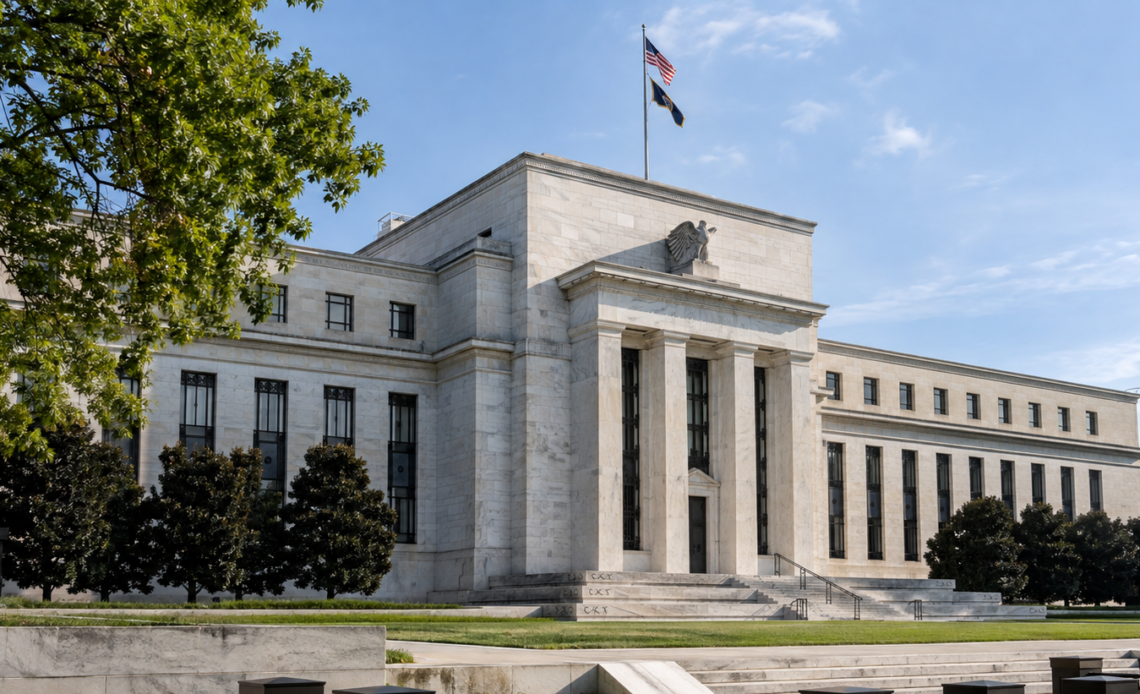
A hawkish Federal Reserve rate increase typically rattles financial markets, yet Wall Street greeted the central bank’s policy pivot without much drama.
On Sept. 16, the Federal Open Market Committee voted 12-0 to lift the benchmark federal funds rate by 25 basis points to a target range of 3.75% to 4.00%.
The unanimous decision marked the central bank’s first increase since 2023, formally ending the prolonged “on hold” stance investors had expected to persist for most of the year.
Yet, several market experts believe the interest rate decision doesn’t mean much for the US stock market.
Strong corporate fundamentals cushion the impact
Larry Adam, chief investment officer at Raymond James, argues that the Fed rate hike will have minimal impact on the equity market due to the underlying resilience of corporate America.
“I don’t think these interest rates do anything to the equity market,” he wrote in his latest report.
Adam points to robust company profits and healthy balance sheets as key factors that continue to insulate businesses from higher borrowing costs.
In his view, these solid fundamentals provide a sturdy foundation for stocks, allowing the market to absorb the policy shift without losing momentum.
This sentiment is shared by other market observers, who emphasize that strong consumer spending and employment show the broader economy remains on solid footing despite tighter monetary conditions.
Historical data points to long-term resilience
UBS also advises investors not to overreact to the initial rate increase – recommending instead a focus on broader economic growth, corporate earnings, and inflation trends.
According to the firm’s analysis, historical data shows US stocks tend to be remarkably “resilient” following the start of a tightening cycle.
Examining 16 Fed rate-hiking cycles dating back to 1954, UBS found that the S&P 500 posted an average gain of 10.8% in the year following the first hike.
While analysts acknowledge that higher rates carry inherent risks, they emphasize that the initial policy shift should not prompt investors to scale back their stock exposure.
Tech giants poised to sustain momentum
Beyond corporate balance sheets and historical precedents, the tech sector heavyweights are well-positioned to weather higher borrowing costs.
Hyperscalers like Alphabet, Amazon, Microsoft, and Meta possess vast cash reserves, allowing them to fund massive infrastructure projects – including data centers, AI servers, and networking hardware – without relying heavily on debt financing.
Because these capital expenditures are fueled by long-term strategic goals rather than short-term interest rates, tech spending is unlikely to falter.
With major industry leaders pressing forward on growth initiatives regardless of central bank policy, the broader stock market retains a powerful engine to sustain momentum through this monetary shift.
Note that the S&P 500 index currently sits less than 2% below its record high.
The post Why the Fed hike may not mean much for US stocks appeared first on Invezz